


New USA Rules for Indian Students

New USA Rules for Indian Students Everything You Need to Know Before Applying The United States has long been the dream destination for thousands of Indian students seeking world-class education, cutting-edge research opportunities, and excellent career prospects. Every year, more than three lakh Indian students travel to the U.S. to pursue undergraduate, master’s, doctoral, and professional degree programs. However, the U.S. immigration system continues to evolve. In 2026, several important changes to student visa regulations and immigration procedures have either taken effect or are in the process of implementation. These updates affect how international students enter the United States, maintain their legal status, plan internships, and prepare for employment after graduation. One of the most significant changes is the move away from the traditional Duration of Status (D/S) system toward a fixed period of authorized stay for many students. Alongside this, visa screening has become stricter, documentation requirements have increased, and students are expected to maintain higher levels of compliance throughout their studies. If you are an Indian student planning to study in the USA, understanding these changes before submitting your university applications or attending your visa interview is essential. This comprehensive guide explains everything you need to know. Why Did the USA Change the Student Visa Rules? The U.S. government periodically reviews immigration policies to improve national security, strengthen immigration compliance, and ensure that temporary visa holders follow the conditions of their stay. According to U.S. authorities, the objectives behind these updates include: Improving immigration monitoring. Preventing visa misuse. Enhancing national security. Creating clearer timelines for student immigration. Increasing accountability among educational institutions and students. These changes are not intended to discourage genuine international students, but they do require students to be more organized and proactive in maintaining their immigration status. The United States has long been the dream destination for thousands of Indian students seeking world-class education, cutting-edge research opportunities, and excellent career prospects. Every year, more than three lakh Indian students travel to the U.S. to pursue undergraduate, master’s, doctoral, and professional degree programs. However, the U.S. immigration system continues to evolve. In 2026, several important changes to student visa regulations and immigration procedures have either taken effect or are in the process of implementation. These updates affect how international students enter the United States, maintain their legal status, plan internships, and prepare for employment after graduation. One of the most significant changes is the move away from the traditional Duration of Status (D/S) system toward a fixed period of authorized stay for many students. Alongside this, visa screening has become stricter, documentation requirements have increased, and students are expected to maintain higher levels of compliance throughout their studies. If you are an Indian student planning to study in the USA, understanding these changes before submitting your university applications or attending your visa interview is essential. This comprehensive guide explains everything you need to know. Major Change #1 – Fixed Period of Stay Replaces "Duration of Status" For decades, most international students entered the United States under Duration of Status (D/S). This meant that students could legally remain in the country as long as they maintained full-time enrollment and complied with F-1 visa regulations. Under the updated framework, many students will instead receive a fixed period of authorized stay, typically: Up to 4 years, or The length of the academic program, Whichever period is shorter. What Does This Mean? For example: Example 1 Rahul receives admission into a two-year Master’s program. His authorized stay will generally match the duration of his program. Example 2 Sneha enrolls in a five-year doctoral program. She may initially receive authorization for four years and later need to apply for an extension if she continues to meet all eligibility requirements. This means students must pay closer attention to the expiration dates on their immigration documents. Major Change #2 – End of "Duration of Status" Previously, students only needed to maintain valid academic status. Now, students must monitor both: Academic eligibility Immigration authorization period Even if your university allows you to continue studying, your immigration authorization may still require an extension. This makes communication with your Designated School Official (DSO) much more important than before. Major Change #3 – Shorter Grace Period After Graduation Traditionally, many F-1 students had approximately 60 days after completing their studies to: Leave the United States Transfer to another university Apply for another academic program Change immigration status Under the updated framework, the grace period may be reduced to approximately 30 days for affected students. Why Does This Matter? This shorter period means graduates have less time to: Find employment Apply for work authorization Prepare documents Arrange travel Change visa status Students should therefore begin planning their post-graduation options several months before completing their degree. Major Change #3 – Shorter Grace Period After Graduation Traditionally, many F-1 students had approximately 60 days after completing their studies to: Leave the United States Transfer to another university Apply for another academic program Change immigration status Under the updated framework, the grace period may be reduced to approximately 30 days for affected students. Major Change #4 – Extension Requests Become More Important Students whose academic programs extend beyond their authorized stay will likely need official approval before remaining in the United States. Extensions are not automatic. Students must demonstrate: Continued enrollment Academic progress Valid financial support Compliance with visa regulations Late applications could create immigration complications. Major Change #5 – Stricter Visa Screening One noticeable trend in 2026 is increased scrutiny during the visa application process. Visa officers are paying closer attention to: Academic history Financial capability English proficiency Career goals Previous travel history Authenticity of documents Students should expect more detailed interview questions than in previous years. Major Change #6 – Stronger Financial Verification Financial documentation has become increasingly important. Applicants should be prepared to show: Bank statements Education loan approvals Sponsor income documents Income tax returns (where applicable) Scholarship letters Fixed deposits Affidavits of support (if required) Financial information should clearly demonstrate the student’s ability to pay tuition
Intakes in USA 2026–2027: Which Intake is Best for Indian Students?

Intakes in USA 2026–2027 | Which Intake is Best for Indian Students? Planning to study in the USA? One of the most important decisions you’ll make is choosing the right intake. Your intake affects everything—from course availability and scholarships to internships and visa timelines. In the USA, there are three main intakes for international students: Fall Intake (September) – Primary and most preferred Spring Intake (January) – Secondary option Summer Intake (May) – Limited and specialized Understanding each intake will help you choose the best option based on your academic goals, budget, and preparation timeline. Overview of Intakes in USA Intake Duration Purpose Fall (September) Sep – Dec Main intake with maximum courses and scholarships Spring (January) Jan – Apr Alternative intake with fewer options Summer (May) May – Aug Limited intake for short-term/specialized programs Fall Intake (September): The Best Choice The Fall intake is the most popular among Indian students and marks the start of the academic year in the USA. Why Fall Intake is the Best: 90% of programs available (MS, MBA, MA, etc.) Maximum scholarships and financial aid Better internship and job opportunities Aligns well with OPT (post-study work) Higher chances for long-term career growth and PR pathways Due to these advantages, most Indian students target Fall intake Fall Intake Timeline (2026–2027) Stage Timeline Applications Open September 2025 Deadline Nov 2025 (Early) / Jan 2026 (Regular) Admission Results March – April 2026 Visa Process May – July 2026 Classes Start August – September 2026 📌 Tip: Apply early to improve admission and scholarship chances. Spring Intake (January): A Strong Backup The Spring intake is ideal if you miss Fall deadlines or need more preparation time. Benefits: Less competition Extra time for test preparation (GRE/IELTS) Good for IT, Engineering, Healthcare programs Limitations: Around 30% fewer courses Limited scholarships Spring Intake Timeline Stage Timeline Applications Open July 2025 Deadline Sep – Nov 2025 Admission Results Oct – Dec 2025 Visa Process Nov 2025 – Jan 2026 Classes Start Jan – Feb 2026 Summer Intake (May): Limited Option The Summer intake is the least common and mainly for short-term or specialized programs. Key Points: Only 10% of programs available Very limited scholarships Suitable for niche fields or urgent admissions 👉 Best considered only if you miss Fall and Spring intakes. Spring Intake Timeline Stage Timeline Applications Open October 2025 Deadline Jan – March 2026 Admission Results Feb – April 2026 Visa Process March – April 2026 Classes Start May – June 2026 Top Universities & Deadlines (Fall 2026) Massachusetts Institute of Technology (MIT) – Jan 5, 2026 Yale University – Jan 2, 2026 Duke University – Jan 5, 2026 University of Pennsylvania – Jan 5, 2026 Princeton University – Jan 1, 2026 When Should You Start Applying? To secure admission in the USA, start your preparation 12–15 months in advance. Step-by-Step Timeline: 12–15 Months Before Research universities Prepare for GRE/IELTS/TOEFL 9–8 Months Before Shortlist universities Check eligibility and deadlines 7–6 Months Before Prepare SOP, LORs, documents 5–3 Months Before Submit applications Apply for scholarships Start visa process 1–2 Months Before Book flights and accommodation Prepare for departure ⚠️ Common Mistakes to Avoid Applying at the last minute Missing deadlines Inconsistent SOP, resume, and LORs Submitting incomplete applications Ignoring visa requirements Copying SOP (plagiarism) 👉 With Munu International, you can avoid these mistakes through expert guidance Why Choose Munu International? 1. 🎓 Expert Career Guidance We don’t just suggest courses—we understand your academic background, interests, and career goals to recommend the best-fit programs and universities. 2. 🏫 Top University Admissions We work with a wide network of reputed universities across the globe. Whether you’re planning for MS, MBA, or undergraduate programs, we guide you step-by-step to secure admission. 3. 📝 Complete Application Support From SOP (Statement of Purpose) to LOR (Letters of Recommendation) and resume building, our team ensures your application stands out. 4. 💰 Scholarship & Financial Guidance Studying abroad can be expensive, but we help you explore: Scholarships Education loans Financial planning options Our goal is to make global education affordable and accessible. 5. 📄 Visa Assistance Visa approval is one of the most crucial steps. We provide: Complete visa documentation support Mock interviews Guidance on financial proofs This increases your chances of successful visa approval. 6. ✈️ Pre-Departure & Post-Arrival Support Our support doesn’t end with admission. We help with: Accommodation guidance Travel planning Pre-departure briefings So you feel confident and prepared before starting your journey. 7. 🤝 Personalized Support Every student is unique, and so is our approach. We provide one-on-one counseling to ensure you get the best guidance tailored to your needs. Key Points: Career Counseling University Selection Application Processing SOP & LOR Assistance Visa Guidance Scholarship Assistance Pre-Departure Support Why Students Trust Munu International Transparent process Experienced counselors High visa success rate Strong student satisfaction Your dream to STUDY IN USA starts here. Register For More Info
Why Study a Master’s in Canada? Top Reasons for Indian Students
Why Study a Master’s in Canada? Top Reasons for Indian Students In recent years, Canada has emerged as one of the most preferred destinations for higher education among Indian students. With more than 300,000 Indian students enrolled in Canadian institutions in 2025, the country continues to attract students due to its globally respected education system, excellent career prospects, and welcoming immigration policies. If you are planning to pursue a Master’s degree abroad, Canada offers a perfect balance of academic excellence, affordability, and long-term settlement opportunities. World-Class Universities and Programs Canada is home to several internationally ranked universities that provide high-quality education and strong research facilities. Prestigious institutions such as University of Toronto, University of British Columbia, and McGill University are consistently ranked among the top universities in global rankings. These universities offer a wide range of Master’s programs in: Business and Management Engineering and Technology Information Technology and Data Science Healthcare and Life Sciences Canadian Master’s programs are designed to combine theoretical knowledge with practical experience. Many universities provide co-op programs, internships, and industry projects that help students gain real-world exposure while studying. Tuition fees for international students typically range between CAD 20,000 and CAD 50,000 per year, which is often lower compared to countries like the USA and the UK. Additionally, scholarships such as the Vanier Canada Graduate Scholarships provide financial support of up to CAD 50,000 annually for outstanding students. Post-Graduation Work Permit (PGWP) and Career Opportunities One of the most attractive features of studying in Canada is the Post-Graduation Work Permit (PGWP). This permit allows international students to stay and work in Canada after completing their studies. Depending on the duration of your Master’s program, you may be eligible for a work permit of up to three years. This gives graduates valuable time to gain professional work experience in Canada and build a strong career foundation. Canada’s job market is particularly strong in sectors such as: Artificial Intelligence and Machine Learning Information Technology and Software Development Healthcare and Biotechnology Renewable Energy and Environmental Sciences Starting salaries for Master’s graduates generally range from CAD 60,000 to CAD 90,000 per year, depending on the field and experience. Many Indian graduates find employment in multinational companies, banks, and technology firms across major Canadian cities. Affordable Living and High Quality of Life While studying abroad can be expensive, Canada offers a relatively affordable cost of living compared to other major study destinations. Cities like Toronto and Vancouver are more expensive, but students can significantly reduce costs by choosing cities such as Winnipeg, Halifax, or Ottawa. Below is an estimated breakdown of expenses for international students: Expense Category Monthly Cost (CAD) Approx. ₹ Equivalent Tuition (avg. Master’s) 1,500–4,000 90,000–2.4 lakhs Rent (shared apt.) 800–1,500 48,000–90,000 Food & Groceries 400–600 24,000–36,000 Transport 100–150 6,000–9,000 Total (per year) ~25,000–40,000 15–24 lakhs Students are also allowed to work part-time while studying, which helps cover daily expenses and reduces financial burden on families. Many universities offer on-campus jobs, research assistantships, and teaching assistant opportunities for graduate students. In addition to affordability, Canada is consistently ranked among the safest countries in the world, providing international students with a secure and comfortable environment to live and study. Welcoming Immigration Policies for Indian Students Canada is known for its transparent and student-friendly immigration system. After completing a Master’s degree and gaining work experience through PGWP, students can apply for permanent residency through programs such as: Express Entry Provincial Nominee Programs (PNPs) Master’s graduates receive additional points in Canada’s immigration system, which significantly increases their chances of receiving an invitation for permanent residency. This makes Canada one of the few countries where education, employment, and immigration are strongly connected. The study permit process is also relatively straightforward, requiring: A valid admission letter from a designated learning institution Proof of financial funds English language test scores such as IELTS or TOEFL These structured and clear procedures make Canada an attractive and reliable destination for Indian students planning their future abroad. Cultural Diversity and Student Life Canada is one of the most multicultural countries in the world, with people from different ethnic, cultural, and linguistic backgrounds living together harmoniously. Indian students in particular find Canada welcoming because of the strong Indian community present in major cities. Students can easily find: Indian restaurants and grocery stores Temples, mosques, and churches Cultural festivals such as Diwali, Holi, and Navratri celebrated on campus Universities also offer Indian student associations that organize cultural events, networking sessions, and support programs for new students. This helps students adapt quickly and reduces homesickness during their initial months abroad. Apart from academics, Canada’s natural beauty—from the Rocky Mountains to Niagara Falls—provides students with opportunities to travel, explore, and maintain a healthy work-life balance during their studies. Is a Master’s in Canada the Right Choice for You? A Master’s degree from Canada not only enhances your academic qualifications but also improves your global career prospects. With world-class universities, affordable education, post-study work opportunities, and a clear pathway to permanent residency, Canada offers long-term value for Indian students. If you are planning for the upcoming intake, it is advisable to start early by researching universities, preparing your documents, and applying for scholarships to increase your chances of admission and visa approval.
Dubai Student Visa Guide for Indian Students
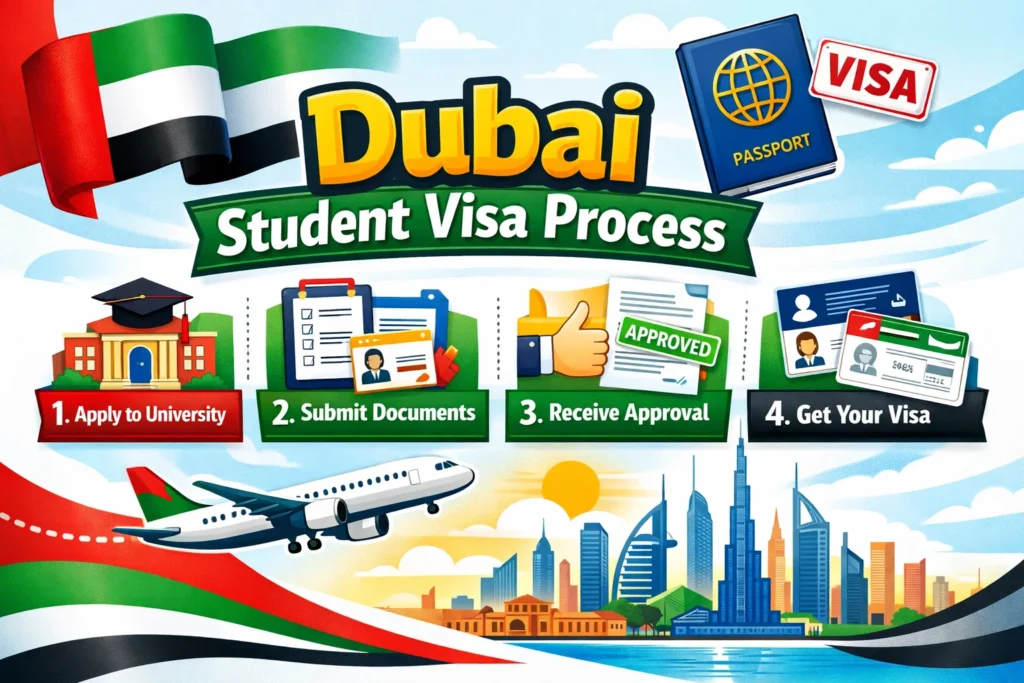
Study in Dubai with Munu International Overseas Education Consultancy International students seeking globally recognized degrees and a vibrant international environment increasingly choose Dubai as their study destination. The city offers world-class universities, modern infrastructure, strong safety standards, and close connections with international businesses. Dubai uniquely combines academic excellence with career opportunities, giving students access to internships, global networking, and exposure to multinational companies. Its strategic location connecting Asia, Europe, and Africa makes it an ideal hub for education and professional growth. As the number of international students continues to grow, understanding the Dubai student visa process has become essential for anyone planning to study in the UAE. Before accepting an offer from a university, students must clearly understand visa requirements, financial criteria, required documents, and the latest 2026 updates. Changes in visa regulations can affect admission timelines, travel plans, and internship opportunities. At Munu International Overseas Education Consultancy, we guide students through every stage of the process—from university selection to visa approval—ensuring a smooth and stress-free journey. Who Needs a Dubai Student Visa? Dubai has become a popular destination for Indian students pursuing internationally recognized degrees in business, engineering, technology, hospitality, and management. Students from Telangana and Andhra Pradesh increasingly choose Dubai because of: Globally accredited universities Strong industry connections Safe and modern lifestyle Excellent career opportunities If you are an Indian passport holder planning to study in Dubai, you must obtain a student residence visa. The visa is usually sponsored by the university you are attending or by a legal guardian living in the UAE. Students enrolling in undergraduate, postgraduate, diploma, or foundation programs must complete visa procedures before the academic term begins. With the help of Munu International Overseas Education Consultancy, students receive complete assistance with: Documentation preparation Financial proof guidance Medical testing Visa application submission Emirates ID processing This support helps avoid delays and visa rejection. Eligibility Criteria for Dubai Student Visa To obtain a Dubai student residence visa, students must meet certain eligibility requirements set by the UAE Immigration Authorities and sponsoring university. Simply getting admission to a university is not enough; students must also meet financial, medical, and security requirements. Key Eligibility Requirements • Admission letter from a recognized university in Dubai• Passport valid for at least six months• Successful completion of UAE medical fitness test• Immigration security clearance approval• Proof of sufficient funds or financial sponsor• Valid UAE health insurance Because immigration policies may change, it is always recommended to seek guidance from experienced consultants. Munu International Overseas Education Consultancy ensures students submit accurate documents and follow the latest UAE regulations. Documents Required for Dubai Student Visa Submitting the correct documents is one of the most important steps in the visa process. Even small errors can delay approval. Since the visa is issued under the sponsorship of the university, both the university and immigration authorities verify all documents carefully. Required Documents • Valid passport with at least six months validity• Recent passport-size photographs as per UAE guidelines• Copy of passport bio page and previous UAE visas (if any)• University admission letter from a recognized institution• Proof of tuition fee payment• Recent bank statements or financial sponsorship letter• Accommodation proof (university housing or rental agreement)• Medical fitness test report• Valid health insurance for UAE• Visa fee payment receipt• Attested academic certificates (especially for postgraduate students) At Munu International Overseas Education Consultancy, our team reviews every document carefully before submission to ensure faster processing. Dubai Student Visa Processing Time Students should ideally start the visa process 1–2 months before the semester begins. Early applications help avoid delays during peak admission seasons. For Indian students, the average processing time is: 15 to 20 working days However, the timeline may vary depending on: Document verification University processing speed Immigration approval Some universities also offer express visa processing, which can reduce the approval time. With expert guidance from Munu International Overseas Education Consultancy, students can ensure their application is submitted correctly and on time. Dubai Student Visa Cost (2026) The cost of a Dubai student visa may vary slightly depending on the university sponsoring the visa. Estimated Student Visa Cost Fee Component Approximate Cost Visa Processing Fee AED 2,300 – AED 2,700 Refundable Security Deposit AED 2,500 – AED 3,000 Medical Insurance AED 1,300 – AED 1,400 Additional costs may include: Emirates ID fees Medical fitness test University service charges Exchange rates may change, so students should confirm the latest fees with their university. Munu International Overseas Education Consultancy provides complete cost transparency before students apply. Step-by-Step Dubai Student Visa Process The Dubai student visa process usually follows these steps: Step 1: Confirm Admission Accept the university offer and pay the tuition deposit. Step 2: Submit Documents Provide passport copies, academic certificates, financial proof, and photographs. Step 3: Entry Permit Application The university applies for the Dubai entry permit through immigration. Step 4: Travel to Dubai Once the entry permit is issued, the student can travel to the UAE. Step 5: Medical Examination Students undergo a medical fitness test and blood tests. Step 6: Emirates ID Biometrics After approval, the student residence visa is stamped in the passport. Step 7: Visa Stamping After approval, the student residence visa is stamped in the passport. With the guidance of Munu International Overseas Education Consultancy, the entire process becomes simple and organized. Popular Courses for Indian Students in Dubai Top courses include: Business Administration (BBA / MBA) International Business Finance and Accounting Hospitality and Tourism Management Computer Science and IT Data Analytics and Artificial Intelligence Civil and Mechanical Engineering Digital Marketing Aviation and Logistics Management Architecture and Interior Design How Munu International Consultancy Helps Students Applying for a student visa can be complicated if you are unfamiliar with visa rules, financial documentation, and medical procedures. Munu International Overseas Education Consultancy simplifies the entire process by offering complete support, including: University selection Admission application assistance Visa documentation guidance Financial proof preparation Scholarship assistance Entry permit processing Medical test coordination Emirates ID registration Our team ensures that students from Hyderabad, Telangana, and Andhra
Study Abroad with Munu International Overseas Education Consultancy
Study Abroad with Munu International Overseas Education Consultancy Studying abroad is a dream for many students who want to gain international education, global exposure, and better career opportunities. However, the process of choosing the right country, applying to universities, arranging finances, and securing a visa can be complex. This is where Munu International Overseas Education Consultancy plays a crucial role in guiding students through every step of their study abroad journey. Munu International Overseas Education Consultancy helps students achieve their dreams of studying in top global destinations such as the USA, UK, Canada, Australia, European countries, and Dubai. With expert guidance and personalized support, students can confidently plan their international education and build a successful future. Why Choose Munu International Overseas Education Consultancy? Munu International Overseas Education Consultancy is dedicated to providing complete study abroad guidance under one roof. From selecting the right course to securing a visa, the team ensures that students receive professional assistance at every stage. Key advantages include: Expert counseling for choosing the right country and course Assistance with university applications Support for scholarships and financial planning Visa guidance and documentation Pre-departure assistance for students The consultancy focuses on making the study abroad process simple, transparent, and stress-free for students and their families. Study Destinations We Offer Munu International Overseas Education Consultancy provides opportunities for students to study in some of the world’s most popular education destinations. United States of America (USA) The USA is home to some of the world’s top universities and offers a wide range of programs in technology, business, science, and research. Studying in the USA provides students with excellent academic resources, internship opportunities, and strong career prospects. United Kingdom (UK) The UK is known for its prestigious universities and high-quality education system. With shorter course durations and globally recognized degrees, the UK remains one of the most preferred destinations for international students. Canada Canada is famous for its welcoming environment, quality education, and post-study work opportunities. Many students choose Canada because of its affordable education and strong immigration pathways. Australia Australia offers excellent universities, a high standard of living, and diverse cultural experiences. Students benefit from world-class education and work opportunities during and after their studies. European Countries Many European countries provide affordable or even low-cost education along with high-quality academic programs. Countries like Germany, France, and others are becoming increasingly popular among international students. Dubai Dubai has rapidly become an international education hub with modern universities and strong career opportunities in business, management, and technology. Financial Support and Scholarships One of the biggest challenges for students planning to study abroad is managing the financial aspect of education. Munu International Overseas Education Consultancy assists students in identifying the best financial options. The consultancy provides guidance on: Scholarships offered by universities Financial documentation and loan support Budget planning for tuition and living expenses With the right guidance, students can reduce their financial burden and access quality education abroad. Complete Guidance at Every Step Studying abroad involves many steps, and proper guidance can make a big difference. Munu International Overseas Education Consultancy supports students throughout the entire process. Services include: Career counseling and country selection University and course selection Application preparation and submission Scholarship guidance Financial documentation support Visa application assistance Pre-departure guidance This step-by-step approach ensures that students feel confident and well-prepared for their international education journey. Start Your Study Abroad Journey Today Studying abroad is not just about earning a degree—it is about gaining global exposure, cultural experience, and better career opportunities. With the right guidance and support, students can turn their dreams into reality. Munu International Overseas Education Consultancy is committed to helping students achieve their international education goals by providing expert advice, reliable support, and personalized guidance. If you are planning to study in the USA, UK, Canada, Australia, Europe, or Dubai, Munu International Overseas Education Consultancy is ready to guide you at every step of your journey. Take the first step toward your global future today. Register For More Info
Study in Australia – Complete Guide for International Students

Study in Australia Complete Guide for International Students Australia has become one of the most preferred study destinations for international students due to its globally ranked universities, excellent education system, and strong career opportunities. Known for its modern infrastructure, safe environment, and multicultural society, Australia provides students with both academic excellence and personal growth. Every year, hundreds of thousands of students from around the world choose Australia to pursue higher education. Australian universities focus on practical learning, research, and industry exposure, helping students develop skills required in the global job market. Students who study in Australia gain internationally recognized qualifications, valuable work experience, and opportunities to build successful careers. Australia is also known for its excellent living standards, healthcare system, and student-friendly policies. From vibrant cities like Sydney and Melbourne to peaceful student-friendly cities like Adelaide and Perth, Australia offers the perfect environment for education and lifestyle. Top Universities in Australia and Global Rankings Australia is home to some of the world’s top-ranked universities. These universities offer high-quality education, modern facilities, and excellent career support. University Name QS World Ranking Location Popular Courses University of Melbourne #13 Melbourne Business, Medicine, Engineering Australian National University (ANU) #30 Canberra IT, Science, Research University of Sydney #18 Sydney Engineering, Management Monash University #37 Melbourne Pharmacy, IT, Business University of Queensland #40 Brisbane Engineering, Biotechnology University of New South Wales #19 Sydney Engineering, Data Science Deakin University #233 Melbourne IT, Business, Healthcare La Trobe University #242 Melbourne Data Science, Management Griffith University #243 Brisbane Hospitality, Engineering James Cook University #415 Queensland Marine Science, Environmental Science These universities are recognized globally, and graduates from these institutions are highly valued by employers worldwide. Tuition Fees in Australia for International Students The cost of studying in Australia varies depending on the university, course, and degree level. However, compared to countries like the USA and UK, Australia offers affordable education with excellent return on investment. Course Level Average Annual Tuition Fees (AUD) Approx Fees in INR Diploma AUD 8,000 – AUD 15,000 ₹4 – ₹8 Lakhs Bachelor’s Degree AUD 18,000 – AUD 35,000 ₹10 – ₹19 Lakhs Master’s Degree AUD 22,000 – AUD 40,000 ₹12 – ₹22 Lakhs MBA AUD 25,000 – AUD 50,000 ₹14 – ₹28 Lakhs PhD AUD 20,000 – AUD 42,000 ₹11 – ₹23 Lakhs Many universities also offer scholarships that can reduce tuition fees significantly. Why Study in Australia? One of the main reasons students choose Australia is the quality of education. Australian universities focus on practical learning, research, and innovation. Students gain hands-on experience through internships, projects, and industry training, which prepares them for real-world careers. Australia also offers a wide range of courses in fields such as Information Technology, Engineering, Business, Healthcare, Nursing, and Data Science. Students have the flexibility to choose programs based on their interests and career goals. Another major advantage is the opportunity to work while studying. International students can work part-time during their course, which helps them gain work experience and support their living expenses. This also improves their communication skills and professional knowledge. Australia is also known for its multicultural society. Students from different countries live and study together, creating a diverse and welcoming environment. This helps students build international networks and develop global perspectives. Living Expenses in Australia The cost of living in Australia depends on the city and lifestyle. However, students can manage their expenses through part-time work. Expense Type Average Monthly Cost (AUD) Accommodation AUD 600 – AUD 1,200 Food AUD 300 – AUD 600 Transport AUD 100 – AUD 200 Other Expenses AUD 200 – AUD 400 Content AUD 1,200 – AUD 2,200 Cities like Adelaide and Perth are more affordable compared to Sydney and Melbourne. Work Opportunities for Students Australia allows international students to work while studying, which is a major advantage. Students can work up to 48 hours per fortnight during academic sessions and full-time during holidays. Part-time jobs are available in restaurants, retail stores, supermarkets, warehouses, and offices. Students can earn between AUD 20 and AUD 30 per hour, which helps cover living expenses. This work experience also improves students’ resumes and increases their chances of getting full-time jobs after graduation. Post-Study Work Opportunities in Australia One of the biggest benefits of studying in Australia is the Post-Study Work Visa. After completing their degree, students can stay and work in Australia for several years. Bachelor’s and Master’s graduates can stay between 2 to 4 years, while PhD graduates can stay even longer. This allows students to gain international work experience and apply for Permanent Residency if eligible. Australia has high demand for skilled professionals in IT, Engineering, Healthcare, and Business, which provides excellent career opportunities for graduates. Scholarships in Australia One of the biggest benefits of studying in Australia is the Post-Study Work Visa. After completing their degree, students can stay and work in Australia for several years. Bachelor’s and Master’s graduates can stay between 2 to 4 years, while PhD graduates can stay even longer. This allows students to gain international work experience and apply for Permanent Residency if eligible. Australia has high demand for skilled professionals in IT, Engineering, Healthcare, and Business, which provides excellent career opportunities for graduates. Student Visa Requirements To study in Australia, students need a Student Visa (Subclass 500). The main requirements include an offer letter from a recognized university, English language test score such as IELTS or PTE, financial proof, passport, and academic documents. The visa process is straightforward when guided properly by experienced education consultants. Career Opportunities After Studying Australia offers excellent career opportunities for international graduates. Many multinational companies operate in Australia and hire international students. Graduates in IT, Engineering, Healthcare, and Business have especially strong job prospects. Australian work experience also increases global career opportunities. Conclusion Australia is one of the best destinations for international students due to its high-quality education, globally ranked universities, affordable tuition fees, and excellent career opportunities. Students benefit from practical learning, multicultural exposure, and post-study work opportunities. With its safe environment, strong economy, and
Study in Finland for Indian Students: Your Ultimate 2026 Guide

Study in Finland for Indian Students: Your Ultimate 2026 Guide Finland has rapidly emerged as one of the most attractive destinations for international students — especially from India. Known for its innovative educational approach, emphasis on research and technology, and a high quality of life, Finland offers promising opportunities for bachelor’s, master’s, and doctoral studies. In this 2026 guide, we will walk you through everything you need to know — from costs and top universities to admissions and student life. Why Choose Finland for Higher Education? Finland’s education system is globally recognized for its high standards, practical learning methods, and research-oriented approach. Unlike many Western countries, Finnish universities emphasize equality, creativity, and innovation, fostering an environment where students can think critically rather than memorize facts. Top Benefits for Indian Students: Quality Education at Lower Cost: Tuition ranges from €8,000 to €20,000 per year — significantly more affordable than many European and North American countries. English-Taught Programs: Many bachelor’s and master’s degrees are offered in English, so language isn’t a barrier. Work While You Study: International students can work up to 30 hours per week during academic terms. Post-Study Work Opportunities: Graduates can stay and work in Finland for up to 2 years after completing their degrees. Safe and Multicultural Environment: Finland consistently ranks high on global safety and student satisfaction indices. Key Highlights (2026) Highlight Details Cost of Studying (per year) €8,000 – €20,000 (~₹8.1L – ~₹20.4L) Cost of Living (per month) €700 – €1,100 (~₹71,609 – ~₹1,12,528) Part-time Work Allowed Up to 30 hours/week Post-Study Work Permit Up to 2 years Top Universities (QS Ranking 2026) University of Helsinki, Aalto University, Tampere University, Lappeenranta-Lahti University of Technology (LUT), University of Oulu Understanding Finland’s Education System Finland’s higher education system stands out for its student-centered, practical, and interactive approach. The system places significant emphasis on problem solving and research, making it ideal for students who want to excel not just academically, but professionally. Key Features: Bachelor’s, Master’s, and Ph.D. Programs: Most programs are available in English, especially at the master’s and doctoral levels. Practical Learning: Universities partner with industries and research institutions to provide internships and hands-on learning. Globally Recognized Degrees: Finnish degrees are accepted worldwide, opening doors for international careers. Top Universities (Popular Among Indian Students) University Key Strengths / Specializations University of Helsinki Life Sciences, Computer Science, Research Excellence Aalto University Engineering, Business, Design, Innovation Tampere University Data Science, Technology, Social Sciences Lappeenranta-Lahti University of Technology (LUT) Renewable Energy, Engineering, Sustainability University of Oulu Technology, Medicine, IT Programs Popular Courses for Indian Students in Finland Field of Study Why It’s Popular Engineering & Technology Strong industry collaboration and research focus Computer Science & IT High demand in AI, data science, and software fields Business & Management Innovation-driven and globally recognized degrees Health Sciences Advanced research and healthcare systems Renewable Energy & Sustainability Finland is a leader in green technology Design & Innovation Practical, creative, and industry-oriented approach Cost of Studying and Living (2026) Tuition Fees Bachelor’s & Master’s: €8,000 – €20,000 per year(Varies by university and program) Engineering & popular tech courses usually fall between €10,000 – €15,000 per year. Living Expenses €700 – €1,100 per month(Includes accommodation, utilities, food, transport, and personal expenses) Typical breakdown: Rent: €400–€700 Food & groceries: €250–€300 Miscellaneous: €100–€200 Work While Studying Part-time work up to 30 hours/week Many student jobs offer around €10/hour, helping offset living costs. Scholarships and Financial Aid Finland offers a range of merit-based scholarships and tuition reductions for international students — including Indians. These funding options can significantly reduce or even eliminate tuition costs. Common Scholarship Types: University Scholarships: Merit-based awards that reduce tuition fees. Government & Funded Scholarships: Offered by educational foundations and research bodies. Program-Specific Awards: Especially in fields like tech and engineering. Eligibility and Required Documents To study in Finland, Indian students generally need: Academic Requirement 60–70% or above in 12th (for Bachelor’s) or undergraduate degree (for Master’s) English Language 60–70% or above in 12th (for Bachelor’s) or undergraduate degree (for Master’s) Required Documents Valid Passport Academic transcripts (10th, 12th, UG) Statement of Purpose (SOP) Letters of Recommendation (LORs) CV/Resume Financial proof showing €6,720 or more per year Health insurance Ph.D. applicants often receive tuition waivers or research funding. Why Finland is Ideal for Indian Students Supportive Environment Finland regularly ranks among the safest countries in the world. Indian students find it easy to adapt to the culture and lifestyle. Nature-Inspired Living The country is known for its green landscapes, clean cities, and high standard of living, making student life both healthy and enjoyable. Innovation Hub Finland is home to world-class research institutes & tech companies. Graduates find opportunities in emerging fields like AI, data analytics & More Conclusion Studying in Finland offers a balanced mix of quality, affordability, and opportunity. With reasonable tuition costs, work opportunities, globally recognized degrees, and a welcoming environment, Finland stands out as a top choice for Indian students planning their higher education abroad in 2026. If you’re considering Finland for your bachelor’s or master’s, start planning early, apply on Studyinfo.fi, and look for scholarship opportunities — your global education journey awaits! Register For More Info
Study in Cyprus: Affordable European Education for Indian Students
Study in Cyprus Affordable European Education for Indian Students Cyprus is rapidly emerging as a popular study destination for Indian students who are looking for affordable, high-quality education in Europe. With English-taught programs, globally recognized degrees, a safe environment, and low living costs, Cyprus offers excellent value compared to traditional destinations like the UK, USA, or Australia. As a member of the European Union, Cyprus provides EU-recognized qualifications, making it an attractive gateway for international careers and further studies across Europe. Why Study in Cyprus? Cyprus offers world-class education at 40–50% lower costs compared to countries such as the UK or USA. Universities follow European education standards, and most programs are taught entirely in English, which makes it easy for Indian students to adapt without language barriers. Key Advantages: Affordable tuition fees and low living costs EU-recognized degrees accepted worldwide Safe and peaceful country with low crime rates Multicultural environment with international students Mild Mediterranean climate year-round Part-time work opportunities during studies Students can work up to 20 hours per week, helping them manage daily expenses while gaining international work experience. After graduation, opportunities are available in fields like IT, business, healthcare, tourism, and engineering. Study Intakes in Cyprus Cyprus universities generally offer two major intakes, with some institutions providing an additional summer intake. Main Intakes: Fall Intake: September – January Spring Intake: February – June Summer Intake (limited programs): May – June It is recommended to apply 6–8 months in advance to secure admission, scholarships, and timely visa approval. Types of Courses in Cyprus Cyprus universities offer a wide range of undergraduate, postgraduate, and doctoral programs, many with a strong practical and industry-oriented approach. Popular Courses for Indian Students: Business & Management (MBA, Finance, Marketing) Information Technology & Computer Science Engineering (Civil, Electrical, Mechanical) Medicine & Dentistry Tourism & Hospitality Management Law & Psychology Program Duration: Bachelor’s: 3–4 years Master’s: 1–2 years PhD: 3–5 years Top Universities in Cyprus Cyprus is home to several well-ranked universities offering English-medium programs and generous scholarships for international students. University Location Type Notable For University of Cyprus Nicosia Public Ranked among top global universities University of Nicosia Nicosia Private Medicine, Blockchain, scholarships up to 50% Cyprus University of Technology Limassol Public Engineering, IT programs European University Cyprus Nicosia Private Business, Medicine Frederick University Nicosia & Limassol Private MBA, Engineering Tuition Fees and Scholarships One of the biggest advantages of studying in Cyprus is its low cost of education. Tuition Fees: Undergraduate & Master’s: €3,000 – €7,000 per year Medicine & Dentistry: €20,000 – €25,000 per year Living Expenses: €300 – €600 per month, including accommodation, food, and transport Scholarships: Merit-based scholarships: 10% – 50% tuition fee reduction University of Nicosia: Scholarships up to 50% Erasmus Mundus Scholarship: Up to €1,400 per month Cyprus Study Visa for Indian Students Indian students need a Type D Long-Stay Student Visa to study in Cyprus for more than 90 days. Visa Requirements: University admission letter Academic documents (Class 10, 12, Bachelor’s – attested) Passport (valid for at least 6 months) Financial proof (€7,000 or more) Medical tests & health insurance Police clearance certificate Visa Process: Apply through the Cyprus Embassy/Consulate Processing time: 1–3 months Visa fee: approx. €60 Entry via Blue Slip, followed by residence permit after arrival Frequently Asked Questions (FAQ’s) 1. Is Cyprus good for Indian students? Yes. Cyprus is affordable, safe, offers English-taught programs, and provides EU-recognized degrees. 2. How much does it cost to study in Cyprus? Tuition fees range from €3,000–€7,000 per year, and living costs are around €300–€600 per month. 3. Can Indian students work while studying? Yes. Students can work 20 hours per week during semesters and full-time during holidays. 4. Is IELTS required for Cyprus? Often not mandatory if prior education was in English. Some universities may ask for IELTS 6.0–6.5. 5. What are the post-study job opportunities? Graduates can find jobs in IT, business, healthcare, engineering, and tourism, with salaries ranging from €17,000 to €80,000 per year depending on role and experience. Conclusion Cyprus is an excellent destination for Indian students seeking quality European education at an affordable cost. With English-taught programs, scholarships, part-time work rights, and EU-recognized degrees, Cyprus offers a perfect balance of academics, career opportunities, and lifestyle. If you are planning to study abroad on a budget without compromising quality, Cyprus should definitely be on your list.
Masters in Italy: The Definitive 2026 Guide for Indian Students

Masters in Italy The Definitive 2026 Guide for Indian Students Italy has rapidly become one of the most attractive destinations for Indian students planning to pursue a Master’s degree abroad. With world-class universities, affordable tuition, over 700 English-taught programs, and generous scholarships, Italy offers an excellent balance of quality education and cost-effectiveness. As of now, 6,100+ Indian students are studying in Italy, choosing top institutions such as Politecnico di Milano and Sapienza University of Rome. If you’re planning for the 2026 intake, this comprehensive guide covers everything you need to know—from eligibility and costs to visas and applications. Why Choose Italy for Masters? Italy hosts more than 96,000 international students, supported by a strong public education system and globally ranked universities. Key Advantages for Indian Students 1) Affordable Tuition Fees Public universities charge €1,000–€4,000 per year, often reduced through the ISEE income-based fee system, sometimes even to near-zero for middle-class Indian families. 2) Wide Range of English-Taught Programs Over 700 Master’s programs are available in English across fields like AI, Engineering, Business, Design, and Fashion. 3) Strong Research & Innovation Focus Italian universities emphasize applied research, particularly in technology, data science, robotics, architecture, and fashion. 4) Post-Study Work Opportunity Graduates can apply for a 12-month post-study work visa, allowing time to find employment in Italy or the EU. 5) Schengen Mobility An Italian student visa allows travel across 29 European countries, giving unmatched international exposure. Top Universities and Popular Master’s Programs in Italy Italy is home to several globally ranked institutions offering industry-relevant Master’s degrees. University Popular Programs Global Ranking Key Fields Politecnico di Milano Computer Science, AI, Data Science Top 150 Engineering & Technology University of Bologna International Management, Finance Top 200 Business & Analytics Sapienza University of Rome Applied Computer Science Top 250 Sciences University of Padova Cybersecurity, Innovation Top 300 Research & Technology Over 25 Italian universities offer Master’s degrees suitable for Indian students, with 500+ English-taught programs available. Eligibility Criteria for Indian Students To apply for a Master’s degree in Italy, Indian students must meet the following requirements: 1) Academic Requirements Bachelor’s Degree: 3- or 4-year degree from a recognized Indian university Minimum GPA: 2.5–3.0 (approximately 60–65%) 2) Language Requirements IELTS: 6.0–6.5 TOEFL: 80+ English-medium certificate may be accepted by some universities 3) Documents Required Statement of Purpose (SOP) 2–3 Letters of Recommendation (LORs) Academic transcripts Passport GRE/GMAT is required only for MBA or select private universities. Work experience is not mandatory for most MS programs. Cost of Studying in Italy & Scholarships 1) Tuition Fees Public Universities: €1,000–€4,000 per year Reduced further using ISEE assessment 2) Living Expenses €800–€1,200 per month, including accommodation, food, transport, and utilities 3) Scholarships for Indian Students DSU Regional Scholarships (Highly popular) Covers tuition fees Provides €2,000–€5,000 annual stipend Merit-based university scholarships Estimated First-Year Cost (after scholarships): €10,000–€15,000 Visa & Application Process for 2026 Intake Step-by-Step Application Timeline Choose Program & Apply (Dec 2025 – Mar 2026) Receive Offer Letter Pre-Enrollment on Universitaly Portal (May–June 2026) Apply for Type D Student Visa Travel to Italy & Apply for Residence Permit Italian Student Visa Requirements Proof of Funds: €6,947 (approx. ₹7.26 lakhs) Last 6 months bank statements 3 years ITR Health insurance with €30,000 coverage Embassy visa slots fill fast—book early. Final Thoughts A Master’s degree in Italy is an excellent choice for Indian students seeking high-quality education, low tuition fees, scholarships, and European exposure. With globally ranked universities, strong research focus, and post-study work options, Italy stands out as one of the best study destinations for 2026. If planned correctly, studying in Italy can be both academically rewarding and financially manageable. Register For More Info
APS Certificate for Indian Students in Germany

APS Certificate for Indian Students in Germany: Fees, Documents, Process & Complete Details If you are planning to study in Germany, one requirement stands above everything else — the APS Certificate. For Indian students, especially those applying for Bachelor’s or Master’s programs in Germany, the APS Certificate has become a mandatory step for both university admission and the student visa process. Germany attracts more than 250,000 international students every year, and with the rising number of applicants from India, German authorities have strengthened academic verification systems. The Akademische Prüfstelle (APS) ensures that your Indian academic documents are genuine, accredited, and meet German academic standards. At Munu International Overseas Education Consultancy, we guide hundreds of students through this process every year. This blog will give you everything you need to know — from fees and documents to application steps and time-saving tips. Highlights of APS Certificate for Indian Students Feature Details Requirement Indian students applying for Bachelor’s or Master’s programs in Germany Application Fee Approx. ₹18,000 Processing Time 3–4 weeks (can extend during peak season) Validity Lifetime validity in most cases Application Mode Online registration + printed form submission + courier Issued By APS India (German Embassy/DAAD), New Delhi Exemptions Scholarship holders, certain PhD applicants, students with international school qualifications What is the APS Certificate? Your certificates are genuine Your academic history matches German standards You are eligible for the program you are applying to Your visa and admission processes move smoothly APS Certification vs WES Evaluation — Key Differences Many students confuse APS with WES. Here’s a simple comparison: Feature Details WES Evaluation Purpose Mandatory for German university admission & visa verification Used for US/Canada admissions, licensing & immigration Issued By APS India (German Embassy/DAAD) World Education Services (Private agency) Focus Authenticity of Indian education & German admission compliance Credit/GPA equivalency for US/Canada Visa Requirement Mandatory for German student visa Not a visa requirement Validity Lifetime in most cases Based on institution requirements If your destination is Germany, APS is mandatory — not WES. Who Needs an APS Certificate? You must apply for the APS certificate if: You are an Indian student applying for Bachelor’s or Master’s courses in Germany (over 90 days). Your highest educational qualification is from India. You are applying for a German student visa. Your German university requires academic verification (most do). Who Is Exempt From APS? You do not need an APS Certificate if: You are receiving a German or EU-funded scholarship. You are applying for a PhD or Postdoctoral program, and APS is not required by your university. You completed schooling or degree from a non-Indian or international curriculum (IB, A-levels). You are attending a short-term language program (less than 90 days). You already hold a German degree. Always confirm with your chosen university as exceptions vary. Is the APS Certificate Mandatory for Indian Students? Yes — for most students. The German Mission in India lists the APS Certificate as a mandatory document for long-term student visa applications. Almost all public universities and several private institutions require it. Skipping APS can lead to: Rejected university applications Visa delays Visa refusal So, it should be one of your first steps when planning to study in Germany. APS Certificate Fees in 2025 Application Fee: ₹18,000 (non-refundable) Must be paid before your verification process begins Always check the official APS India website for updated payment details APS Processing Time & Validity Processing Time Average: 3–4 weeks Peak seasons: 4–6 weeks or more Missing or unclear documents = delays Validity APS Certificate is valid for life for most students. If you change your study program (e.g., UG → PhD), APS may request additional documents. Once issued, you can reuse it for multiple universities, multiple intakes, and even future degrees. Documents Required for APS Certificate Document Description APS Application Form Download, sign, and submit Passport Copy First & last page Recent Photos As per APS guidelines Class 10 & 12 Certificates Mark sheets + pass certificates Degree Certificate (for PG) Final degree or provisional All Semester Mark Sheets Consolidated or individual National ID Aadhar or similar Language Certificates IELTS/TestDaF/Goethe (if required) Payment Proof Fee payment confirmation Make sure all scans are clear, colour, and A4-sized. How to Apply for the APS Certificate (Step-by-Step Guide) Step 1: Visit APS India Website Select “Study in Germany” and start your application. Step 2: Create Your Account Register with your name, email, and basic information. Step 3: Fill the Application Form Enter academic history, personal details, and study plans. Step 4: Pay the Fee Transfer the ₹18,000 and save the receipt. Step 5: Prepare Your Documents Print, sign, and organise your documents in the correct order. Step 6: Courier Documents to APS India Send your application to the APS office in New Delhi. Step 7: Attend Interview (If Required) Typically for students who haven’t completed their degree yet. Step 8: Track Status Check the APS portal regularly. Step 9: Receive Certificate You will get a digital PDF and/or printed copy. Once done, attach it to your university and visa applications. How to Speed Up Your APS Certificate Process APS verification can slow down if you’re not careful. Here’s how to avoid delays: Submit complete documents in one go Ensure all scans are clear and readable Apply early (avoid peak intake months) Follow APS instructions exactly Respond immediately to clarification emails Check if any documents require translation Keep payment receipts ready Being organised can save you weeks of unnecessary waiting. Conclusion The APS Certificate is one of the most essential steps in your Germany study journey. It verifies your academic background, builds trust with universities, and ensures a smooth visa process. At Munu International Overseas Education Consultancy, we support students through every step — from APS application and university shortlisting to German language coaching and visa filing. If you are planning for Germany in 2025, start your APS process early for a stress-free admission experience. Frequently Asked Questions (FAQ’s) 1. Can I apply for APS before completing my degree? Yes. Final-year students may